

| Titre de la revue Actualité en allergologie et en immunologie au Canada. |
| Périodicité de la publication 3 fois par année (mai, août, décembre) |
| DOI 10.58931/cait |
Archives
-

Volume 5, Issue 2, Fall 2025
- Updates on the Treatment and Management of Urticaria in 2025
- Venom Immunotherapy in 2025: Practical Insights for Community Allergists
- Pearls from the European Academy of Allergy and Clinical Immunology (EAACI) Congress, 2025
-

Volume 5, Issue 1, Spring 2025
- Emerging Biologics in the Management of Atopic Dermatitis
- Updates in Epinephrine Guidelines
- Use of the REMA Score to Distinguish Individuals with Systemic Mastocytosis From Those with Hereditary Alpha-tryptasemia
- The Evolving Therapeutic Landscape for Hereditary Angioedema in Canada: Clinical Advances and Unmet Needs
- An Update on Biologics in Pediatric Asthma: A Canadian Perspective
-
Special Supplement, Winter 2025
- Real-world Experience with Advanced Long-term Prophylaxis Agents to Treat Hereditary Angioedema in Canada
-
Volume 4, Issue 3, Fall 2024
- A Practical Approach to NSAID Allergy David
- Occupational Asthma Management
- Treatment and Management of Chronic Cough in Children
- Pearls from the 2024 European Respiratory Congress
- At-home Management of Food-induced Anaphylaxis
-
Volume 4, Issue 2, Summer 2024
- Secondary Hypogammaglobulinemia
- Understanding and Managing Adenotonsillar Hypertrophy in Pediatric Otolaryngology
- Abstract Presentation Highlights from the 2024 EAACI Annual Meeting
- Allergen Immunotherapy and Atopic Dermatitis: Updated Guidance
- Pollen Cross-Reactivity: A Primer for Allergy Specialists
-
Volume 4, Issue 1, Spring 2024
- Surgical Management of Allergic Rhinitis
- Adult Obstructive Sleep Apnea: A Practical Guide for the Allergist
- Shared Decision Making in Asthma Treatment: Using Motivational Communication to Elevate Your Consultations
-
Special Supplement, January 2024
- Berotralstat: A data review of a novel oral medication for the treatment of hereditary angioedema
-
Special Supplement, May 2023
- Assessment of Measurement-Based Care to Improve Outcomes in Patients with Allergic Rhinitis in an Open-Label, Prospective Study
-
Volume 3, Issue 3, December 2023
- The use of IVIG for allergy consultants
- Allergic conjunctivitiis: Treatment updates and long-term monitoring
- Hydrogen and methane breath testing for abdominal bloating of small intestinal origin
- Epinephrine auto-injectors in Canada: A review of available products and clinical proposals
-
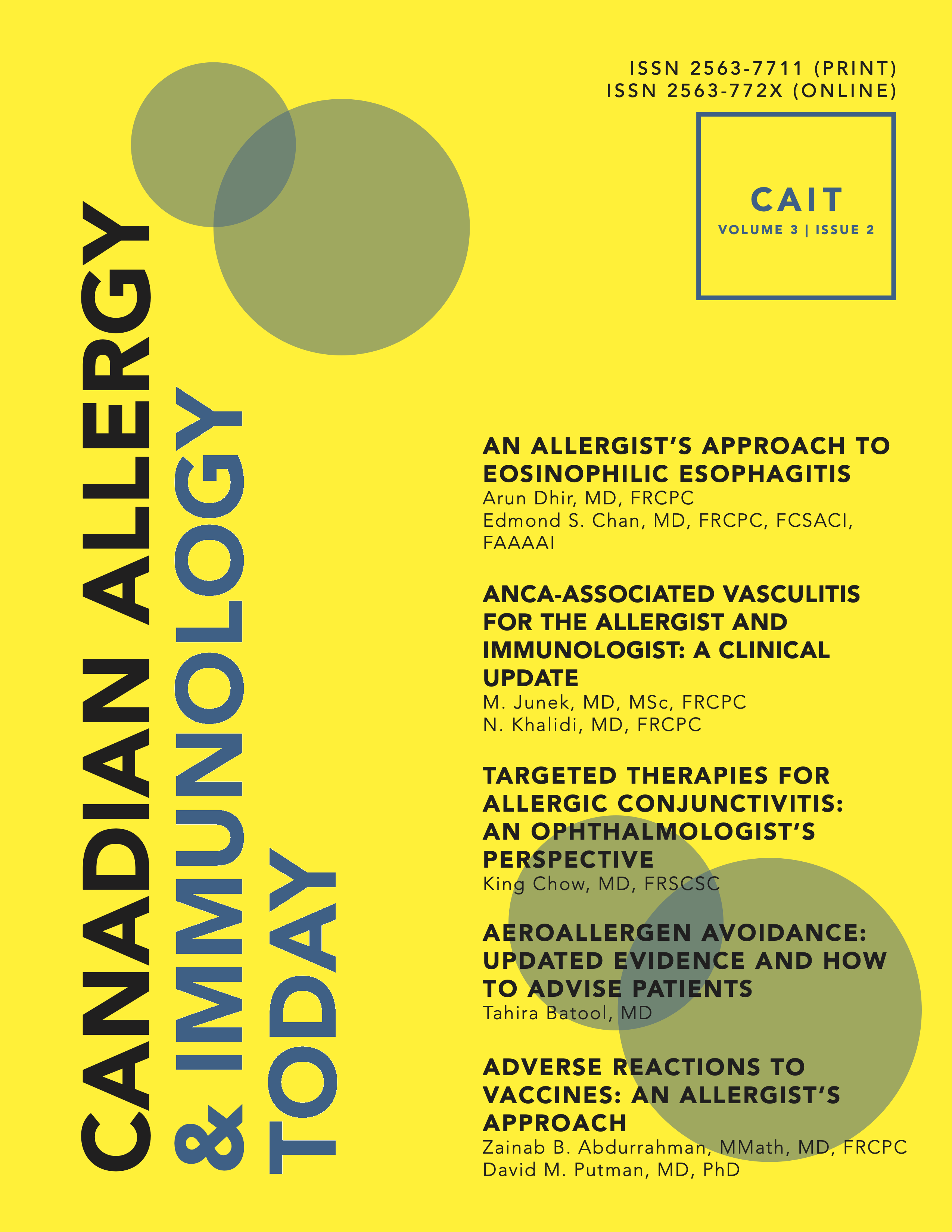
Volume 3, Issue 2, August 2023
- An Allergist's Approach to Eosinophilic Esophagitis
- ANCA-Associated Vasculitis For the Allergist and Immunologist: A Clinical Update
- Targeted Therapies for Allergic Conjunctivitis: An Ophthalmologist's Perspective
- Aeroallergen Avoidance: Updated Evidence and How to Advise Patients
- Adverse Reactions to Vaccines: An Allergist's Approach
-
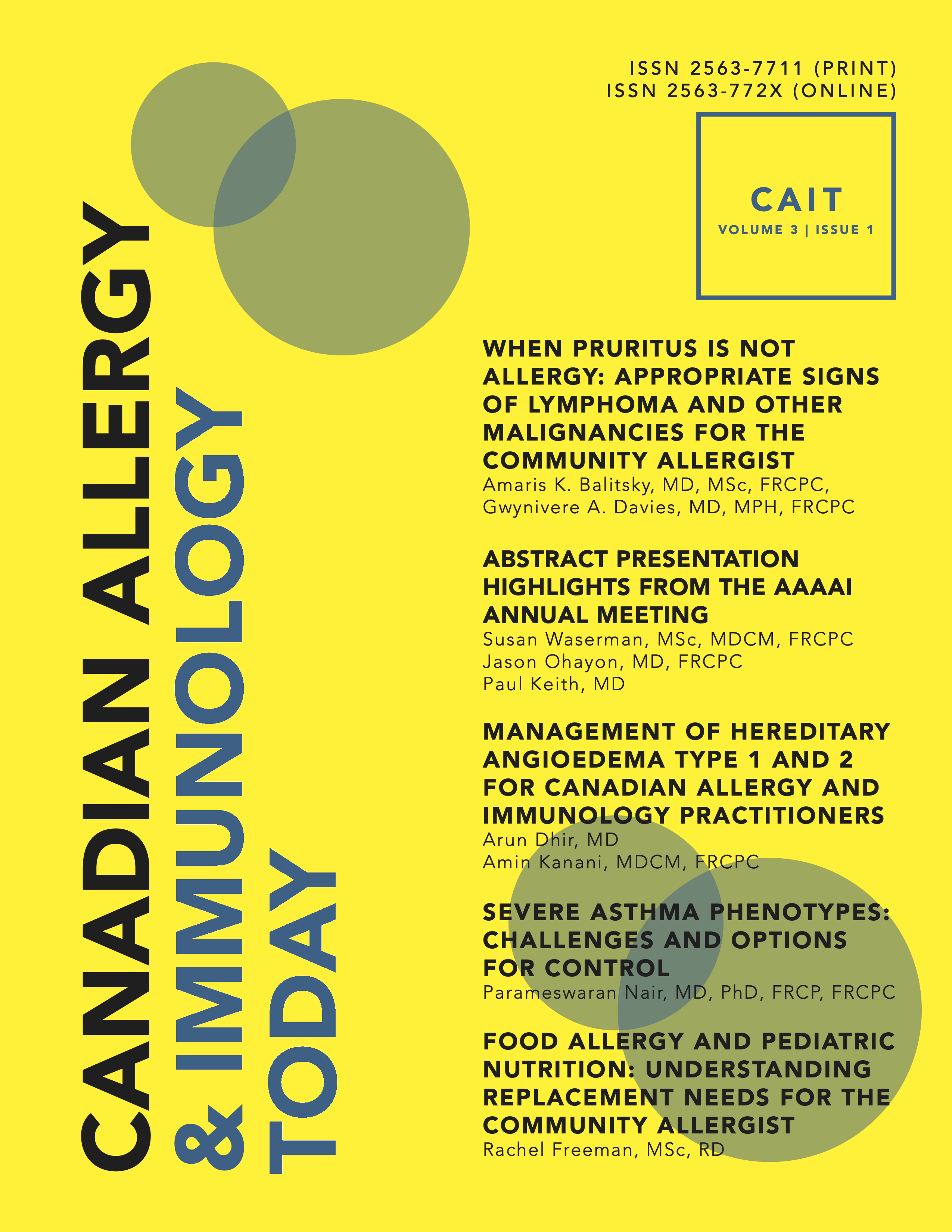
Volume 3, numéro 1, mai 2023
- When Pruritus is Not Allergy: Appropriate Signs of Lymphoma and Other Malignancies for the Community Allergist
- Abstract Presentation Highlights From the 2023 AAAAI Annual Meeting
- Management of Hereditary Angioedema Type 1 and 2 for Canadian Allergy and Immunology Practitioners
- Severe Asthma Phenotypes: Challenges and Options for Control
- Food Allergy and Pediatric Nutrition: Understanding Replacement Needs for the Community Allergist
-
Special Supplement, November 2022
- The Evidence and Clinical Rationale for the Use of JAK Inhibitors in the Management of AD
-
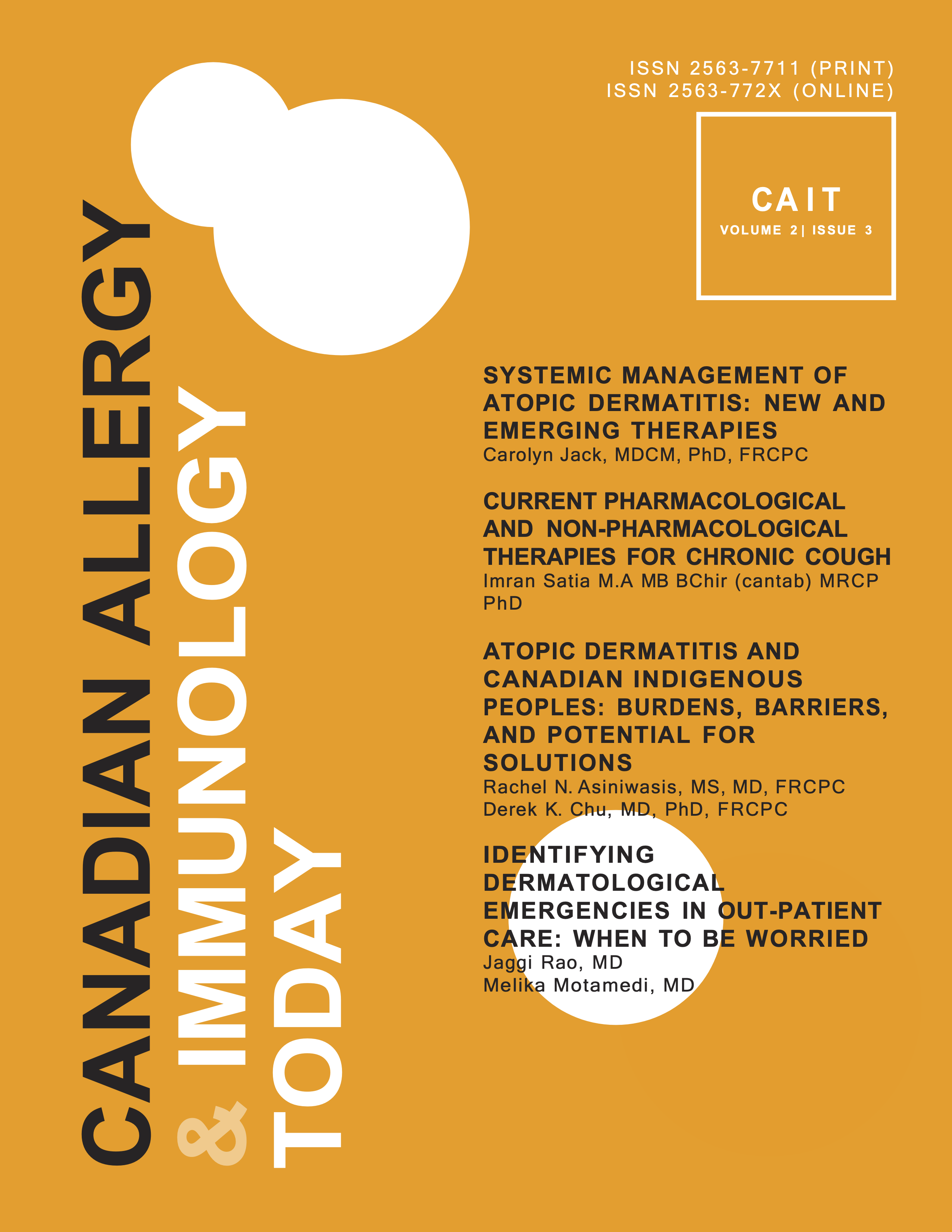
Volume 2, Issue 3, December 2022
- Systemic Management of Atopic Dermatitis: New and Emerging Therapies
- Current Pharmacological and Non-Pharmacological Therapies for Chronic Cough
- Atopic Dermatitis and Canadian Indigenous Peoples: Burdens, Barriers, and Potential for Solutions
- Identifying Dermatological Emergencies in Out-Patient Care: When to be Worried
-
Supplément spécial, mars 2022
- Le rôle des mastocytes dans les maladies atopiques : Au-delà de la sécrétion d’histamine
-

Volume 2, Issue 2, July 2022
- Understanding, Preventing and Managing Food Allergy in Preschool Children: Part 1
- The Use of Biologics in Food Therapy
- Hypereosinophilia: A Guideline for Workup in the Allergy Community
- An Overview of Cannabis Allergy
-
Supplément spécial, novembre 2021
- Similitudes, traitements émergents et fardeau des maladies à lymphocytes T auxiliaires de type 2
-

Volume 2, numéro 1, avril 2022
- Test de provocation alimentaire orale basé sur les composants, au sein de la communauté
- Une nouvelle ère : Recherche sur le rôle du traitement par anticorps monoclonaux destiné à traiter la rhino-sinusite chronique avec polypose nasale
- Asthme et grossesse : Quand il faut penser à deux (ou plus) au lieu d’une
-

Volume 1, numéro 3, décembre 2021
- Mise à jour sur certains sujets relatifs à la rhinosinusite chronique avec polypes nasaux
- La prise en charge médicale des polypes nasaux
- La prise en charge médicale de l’oesophagite à éosinophiles
- Dyskinésie ciliaire primitive : Un aperçu
- Immunothérapie allergénique pour la prise en charge de la rhinoconjonctivite allergique
-
Supplément spécial, juin 2021
- Nouveaux traitements topiques administrés par voie intranasale dans la prise en charge de la rhinite allergique
-
Volume 1, numéro 2, juin 2021
- Troubles mastocytaires : Survol, perles cliniques et approches
- Démangé d’en savoir plus : Surmonter les obstacles à une prise en charge efficace de la dermatite atopique
- Traitement de l’anaphylaxie et modifications pendant la covid-19
- Hypersensibilité aux piqûres d’insectes
- Allergie à l’amoxicilline : Anciens concepts, nouveaux concepts et changement de concepts
-
Supplément spécial, mars 2021
- Prise en charge de l’urticaire chronique et des démangeaisons : Quoi d’autre que l’inhibition de l’action de l’histamine? : L’importance du facteur d’activation plaquettaire dans l’urticaire et sa prise en charge
-
Volume 1, numéro 1, mars 2021
- Prise en charge de l’asthme : Survol des recommandations de la GINA de 2019
- Angio-œdème médié par la bradykinine
- Immunothérapie orale : Aperçu des études principales
- Les antihistaminiques dans le traitement de l’USC : Points de pratique
- Réintroduction des aliments dans des cas de SEIPA
-

Supplément spécial, février 2021
- Vue d’ensemble de la nouvelle mise à jour de la classification ARIA (Allergic Rhinitis and Its Impact on Asthma) de 2019